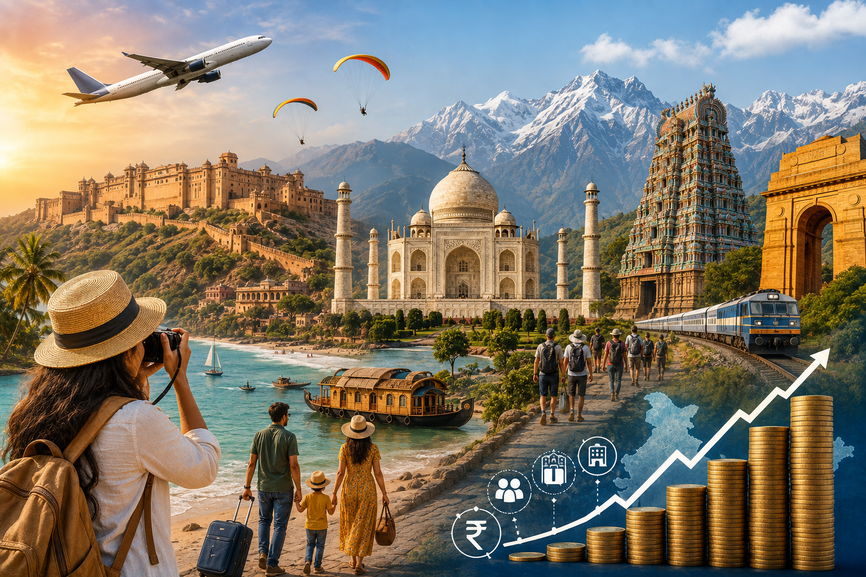
India’s tourism sector is increasingly emerging as a potential engine of economic growth, with government initiatives and changing consumer preferences creating opportunities across hospitality, transport, entertainment, adventure and local businesses. Industry leaders believe the next phase will be less about simply increasing tourist numbers and more about generating greater economic value from every journey.
Amit Garg, Director, Garg Holidays, said tourism is “no longer on the sidelines of India’s economic story” and is increasingly becoming a growth priority. He pointed to the Union Budget 2026–27’s focus on tourism, along with initiatives such as Swadesh Darshan 2.0, heritage and Buddhist circuits, tourism skilling, and the growing focus on medical, spiritual and eco-tourism.
Garg also highlighted the focus on Purvodaya states, which could bring new destinations into the tourism ecosystem and distribute economic benefits more widely. He said sustained reforms and stronger government-industry collaboration could make tourism a defining pillar of India’s long-term growth.
The opportunity is particularly significant in rural and remote regions. Vaibhav Kala, Founder of Aquaterra Adventures, said adventure tourism, despite being one of the fastest-growing segments, remains structurally undercapitalised. A single rafting or trekking operation can create jobs for local guides, cooks and porters while generating additional demand for homestays, transport and small retailers.
However, Kala identified policy fragmentation as a key constraint, citing variations in permits, safety standards and land-use approvals between states. He called for a national framework covering standardised safety certification, transparent permits and permit-linked insurance to unlock private investment and expand adventure tourism into remote geographies.
Read more:- Samsung ennovateX 2026 Brings Together Industry, Academia and Start-ups to Advance AI Innovation
Rohit Kohli, Joint Managing Director, Creative Travel family of brands, said India needs to move “beyond volume to value.” Longer stays, higher-spend experiential travel, better regional connectivity and the development of destinations beyond established circuits could increase tourism’s economic contribution. Technology and travel startups, he added, can help personalise demand and make unique experiences more accessible.
Cruise tourism offers another growth avenue. Akansha Agarwal, Co-founder and CMO of Int2Cruises, highlighted India’s 7,500-km coastline, 12 major and 200 minor ports, more than 20,000 km of navigable waterways and around 1,300 coastal and riverine islands. She said the Cruise Bharat Mission could help build a larger cruise economy, with passengers generating demand for local transport, restaurants, attractions, shopping and experiences.
Meanwhile, experience-led tourism is reshaping the sector. Dhimant Bakshi, CEO of Imagicaaworld Entertainment Limited, said travellers are increasingly seeking memories rather than merely destinations. Adventure, entertainment, wellness, culture, food and immersive attractions can drive spending across hospitality, F&B, transport, retail and local businesses.
Ultimately, India’s tourism opportunity lies not simply in attracting more visitors but in encouraging them to stay longer, spend more and explore more destinations. With stronger infrastructure, policy coordination, private investment and experience-led offerings, tourism could become a powerful engine for employment, investment and more geographically distributed economic growth.
Follow: InsightConvey