

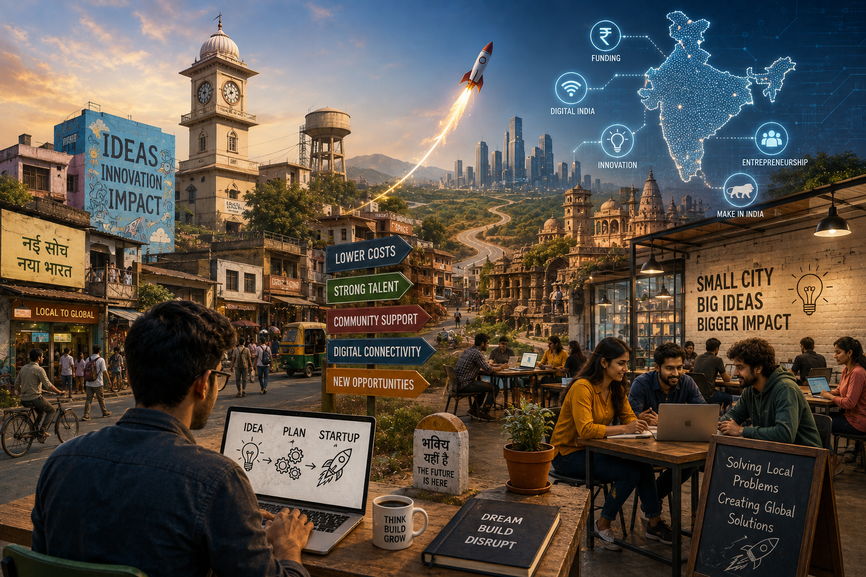
India’s startup ecosystem is beginning to look less like a handful of metropolitan hubs and more like a nationwide network of emerging entrepreneurial centres. The growth of Tier-II and Tier-III cities is being supported by affordable technology, lower operating costs, expanding consumer markets and improving infrastructure. The bigger question now is whether these advantages can translate into the next generation of large, scalable Indian startups.
Access, rather than ambition, appears to be the biggest change. Jatin Ahuja, MD, Big Boy Toyz, believes entrepreneurial ambition has always existed beyond the metros, but founders today have far greater access to technology, customers and markets. Entrepreneurs in cities such as Indore, Jaipur, Surat and Coimbatore can build businesses without relocating to traditional startup hubs. Their proximity to non-metro consumers can also provide a deeper understanding of purchasing behaviour and everyday problems, creating opportunities that conventional startup ecosystems may overlook.
That geographical shift is already reflected in the startup numbers. Sijo Jose, Co-founder and Director, Property Acquisition at SpazeOne, points out that more than 50% of DPIIT-recognised startups are now from Tier-II and Tier-III cities. He attributes the trend to improving digital infrastructure, access to talent and operating costs that can be 30–40% lower than in metros. As coworking spaces, mentorship networks and funding opportunities expand geographically, he expects the smaller-city ecosystem to become more inclusive, distributed and resilient.
Read more:- Can Tourism Become India’s Next Major Growth Engine?
But the opportunity is not simply about building cheaper versions of metro businesses. Dr Sujata Seshadrinathan, Co-Founder & Director, Digital Transformation, Basiz Fund Service Private Limited, sees considerable potential in startups solving problems specific to agriculture, manufacturing, healthcare, logistics, education, regional commerce and vernacular software. Smaller cities, she argues, can provide the problem-solving environment from which businesses develop solutions for local needs and subsequently scale them across wider markets.
Pooja Rokade, Director, Star Bio Pharma Global Pvt Ltd, similarly sees the emergence of specialised business clusters outside the traditional startup centres. With nearly half of DPIIT-approved startups coming from smaller towns, she believes the foundations for a more digitally enabled and cost-efficient entrepreneurial ecosystem are already in place. Manufacturing, healthcare innovation and supply chains could particularly benefit as startups increasingly operate closer to regional markets and develop expertise around local industrial strengths.
The consumer opportunity is also expanding rapidly. Akash Sinha, Managing Director of Le Reve Franchise, believes rising internet penetration, improving infrastructure and digital connectivity are allowing entrepreneurs to pursue ambitious business models beyond metros. Smaller cities offer lower operating costs, untapped talent and growing consumer demand. The increasing interest in taking premium brands into these markets, he says, demonstrates that entrepreneurial opportunity and consumer aspirations are becoming increasingly distributed across the country.
For Sajal Srivastava, Founder & Director of Swad & Masala Food and Beverages Pvt. Ltd., this changing market environment creates an opportunity to build businesses incrementally. Smaller markets can allow founders to understand local demand, test products and refine operating models before expanding into other cities. He also believes the wider impact of this trend could be significant, as encouraging more young Indians to become entrepreneurs and job creators could generate employment while contributing to the next phase of economic growth.
Rishabh Garg, Founder & Developer of Bharat Signage, believes technology has removed many of the barriers that once made location critical for startups. Affordable internet, cloud platforms and digital tools now allow entrepreneurs to access customers and build businesses from smaller cities. More importantly, founders operating close to customers in retail, healthcare, education and local commerce can identify real-world challenges faster. That local understanding, combined with nationwide digital reach, could become a significant competitive advantage.
Yet access to opportunity does not automatically mean access to capital. Manas Sunita Pal, Co-Founder, PedalStart, believes smaller-city founders already have the talent and ambition required to build successful businesses. Lower rents and salary costs can provide entrepreneurs in cities such as Indore and Jaipur with additional runway compared with metro-based startups. However, capital and experienced mentorship remain concentrated in major cities. Bringing these resources closer to founders could be critical to converting local entrepreneurial activity into high-growth companies.
Nakul Jain, Co-Founder, CEO, Aplyd & Partner, Athena, also sees support infrastructure as the next major requirement. Digital infrastructure and technologies such as AI are creating new avenues for innovation, but founders need more than technology to scale. Access to capital, mentorship, skilled talent, customers and institutional partnerships will determine whether promising businesses can move from regional markets to national and global opportunities.
Physical infrastructure will be equally important. Bhanutej Mallangi, Chief Product Officer, ROQIT, highlights logistics as a key factor in making smaller-city entrepreneurship commercially viable. Better roads, warehousing, last-mile delivery and technology-enabled fleet management can help businesses connect with suppliers and customers beyond their immediate geography. At the same time, logistics itself offers opportunities for startups using AI, route optimisation, connected fleets and predictive asset management.
The emerging picture is therefore not one of smaller cities replacing Bengaluru, Mumbai or Delhi-NCR. Instead, India could be moving towards a multi-centre startup ecosystem, where entrepreneurs build around local strengths while accessing national and global markets. The foundations talent, ambition, digital access and lower costs—are increasingly present. The next decisive step will be taking capital, mentorship, infrastructure and market access to where the founders already are.
If that happens, India’s next major startup success story may not emerge from an established technology corridor. It could come from a smaller city where an entrepreneur is solving a local problem that eventually turns out to be a national opportunity.
Follow: InsightConvey


